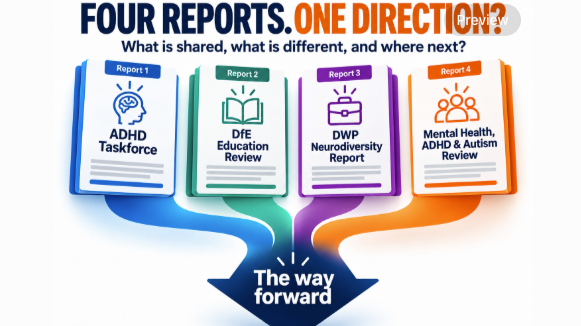
Four reports. Four perspectives. One direction of travel?
Posted on: October 26, 2026
Share this post:


Professor Amanda Kirby, Founder of Do-IT Solutions., Campaigner for Neurodiversity, Medic, Knowledge Translator, researcher.
Originally published as part of The Neurodiversity 101 LinkedIn Newsletter.
Are we finally moving from talking about neurodiversity to changing the systems that shape people’s lives?
Over the past 16 months I have been living and breathing this…., four important independent reports have been published in England. They examine ADHD, autism, neurodiversity, mental health, education and employment. They don’t examine DCD, DLD, Dyslexia, Dyscalculia, Tic Disorders or acquired conditions…
Each was commissioned for a different purpose. Each draws on research, professional expertise and lived experience. Each makes recommendations to government.
But reading them together, something interesting emerges.
Despite their different starting points, they repeatedly point towards the same fundamental problem: our systems are often organised around diagnostic labels, services and processes rather than responding effectively to people’s needs.
Having chaired the Department for Work and Pensions (DWP) Expert Academic Panel on Neurodiversity, I have been particularly interested in where our conclusions intersect with those of colleagues examining health and education.
There is considerable agreement. There are also important differences.And perhaps I think the greatest challenge is no longer identifying what needs to change, but deciding how to make it happen.
First, what are the four reports?
1. NHS England’s Independent ADHD Taskforce — June and November 2025
Commissioned to examine ADHD across the lifespan and chaired by Professor Anita Thapar, this thorough report considers the consequences of unsupported ADHD, access to diagnosis and treatment, and the importance of coordinated action across health, education, employment and justice.
It highlights the risks associated with delayed recognition and treatment, and calls for earlier intervention alongside improved clinical services.
2. Department for Education’s Neurodivergence Task and Finish Group — February 2026
Chaired by Professor Karen Guldberg, this report considers how mainstream education can better support neurodivergent children and young people.
It focuses on four priorities:
- timely identification of strengths and needs;
- workforce development;
- inclusive learning environments, curriculum and assessment;
- funding, accountability and commissioning.
Importantly, it advocates educational assessment and support that do not depend on a clinical diagnosis.
3. DWP Expert Academic Panel on Neurodiversity — October 2026
Our panel examined the barriers facing neurodivergent people in obtaining, retaining and progressing in employment. We deliberately moved beyond ADHD and autism to consider a broader range of neurodivergent profiles, including dyslexia, DCD/dyspraxia, Developmental Language Disorder, dyscalculia, tic disorders and acquired conditions such as traumatic brain injury.
We emphasised a needs-led approach, recognising that support must reflect the individual, the tasks they undertake and the environment in which they work.
We also recommended moving towards Universal Design, where accessibility and inclusion are built into workplace systems from the outset rather than relying solely on adjustments after difficulties arise.
4. Independent Review into Mental Health Conditions, ADHD and Autism — October 2026
One week later the report led by Professor Peter Fonagy has come out ( after many leaks), this review considers changes in mental health needs, ADHD and autism diagnosis, increasing demand for assessment, and how services can respond more effectively.
It proposes moving towards a needs-led plus diagnosis approach, making support available earlier while retaining access to high-quality clinical assessment and treatment. It also argues that success should be measured through participation and quality of life, not simply the number of assessments or diagnoses.
What do all four reports have in common?
1. Needs should matter more than labels when deciding practical support
Perhaps the clearest shared message is that people should not have to wait for a diagnosis before receiving support that could reasonably be provided now.
A child struggling to understand classroom instructions needs help with comprehension. An employee who cannot manage competing demands may benefit from clearer priorities, written instructions or changes to workload. Neither example necessarily requires a diagnostic label before action is taken.
All four reports, in different ways, challenge the idea that formal diagnosis should be the principal gateway to everyday support.
But this does not mean diagnosis is unimportant.
I am not implying that!Diagnosis can provide explanation, access to evidence-based treatment, recognition of disability and a better understanding of associated needs.
The distinction is between needing a diagnosis for particular clinical decisions and unnecessarily requiring one before making practical changes.
2. The environment matters
A person’s difficulties are not experienced in isolation.
Consider someone who finds focusing or concentrating difficult at times. Their performance may change depending on noise, interruptions, sleep, clarity of instructions, task demands and the behaviour of those around them.
- The DfE report recognises that learning environments, behaviour policies and assessment methods may create barriers.
- The DWP report similarly considers job design, workplace environments, communication and management practices.
- The NHS ADHD Taskforce recognises that educational and social environments influence outcomes, while the Fonagy review places greater emphasis on the wider social and economic circumstances affecting people’s lives.
We cannot understand how someone is functioning without considering what they are being asked to do, where they are doing it and what support is available. We need to consider others around them too.
This does not remove the importance of individual differences or clinical conditions. It recognises that outcomes emerge from the interaction between the person and their circumstances.
3. Earlier support may prevent accumulating difficulties
- The NHS ADHD Taskforce highlights the association between unsupported ADHD and adverse outcomes, including educational difficulties, unemployment, mental health problems and contact with the criminal justice system.
- The DfE report identifies how inaccessible education can contribute to absence, exclusion and longer-term disadvantage.
- Our DWP panel examined how inadequate workplace support, poor job fit and difficult relationships can affect wellbeing, performance and employment retention.
- The Fonagy review similarly emphasises early support and prevention.
There is an important distinction between recognising increased risks and assuming inevitable outcomes.
Not every child with ADHD will experience educational failure. Not every neurodivergent employee will struggle at work.
BUT repeated barriers, failures to recognise needs and delays in support may compound difficulties over time.
Why wait until someone is failing, excluded, unwell or unemployed before asking what might help? I feel strongly about that!
4. Professionals need skills, not just awareness
Another recurring theme is workforce capability.Teachers need to understand learning differences and adapt their teaching.Healthcare professionals need the competence to recognise presentations, assess accurately and provide appropriate treatment.Employers and managers need to know how to discuss needs, make adjustments and review whether these work.
This requires more than a one-hour awareness session.It requires practical skills, opportunities to apply them, appropriate supervision, organisational support and continuing evaluation.
We also need to distinguish between understanding a condition and understanding an individual.
Knowing that someone has ADHD, autism or dyslexia does not automatically tell us what they find difficult, what they do well or which support will be effective. I have discussed this many times. A tick list is never the answer!
5. We need to measure what actually matters
There is considerable agreement that delivering an intervention is not the same as achieving an outcome.
- A completed assessment is not necessarily improved functioning.
- A training certificate does not demonstrate an inclusive workplace.
- An adjustment being agreed does not mean it has worked if we don’t review it and be ready to adjust more…
It’s not once and done!
- For the DfE group, success includes children feeling that they belong in school and being supported to achieve and prepare for adulthood.
- For the DWP panel, it includes obtaining and sustaining employment, progression and improved workplace experiences.
- For the NHS ADHD Taskforce, it includes access to effective care and better outcomes across the lifespan.
- For the Fonagy review, improved participation in education, employment, relationships and community life is central.
The question should not simply be, “What have we delivered?” BUT and and an important BUT “What difference has it made?”
But the reports are not saying exactly the same thing
These differences are important.
- The ADHD Taskforce places particular emphasis on under-recognition, undertreatment and the need to improve access to effective ADHD care.
It argues that increasing support outside diagnostic pathways must happen alongside improving clinical services, not instead of them.
- The Fonagy review takes a broader view of diagnostic demand and quality.
It considers underdiagnosis, misdiagnosis and possible overdiagnosis, while acknowledging important gaps in population evidence. It distinguishes increasing numbers of recorded diagnoses from changes in underlying prevalence.
There is a risk of oversimplifying this discussion into whether we are diagnosing too many or too few people.Both can be concerns in different populations or circumstances, and the available evidence does not justify reducing the issue to one headline.
- The DfE report focuses on creating more inclusive mainstream education.
Its recommendations include validated educational needs-assessment tools, more flexible curricula and assessment, workforce development, and funding arrangements that reflect need rather than relying solely on diagnostic rates.
- The DWP panel is more explicit about employment rights, accountability and Universal Design.
Our recommendations include improving Access to Work, reforming Disability Confident, introducing disability employment and pay gap reporting, and requiring employers to respond to adjustment requests within two weeks. Some recommendations but not all have been agreed.
We also highlight the limited evidence for some widely promoted neuroinclusion initiatives and the need for better evaluation.These are complementary perspectives, but we should not pretend that every report makes identical recommendations.
What is still missing?
Reading all four reports raises some further questions for me.
First, what happens between services?
I have too many times across my career seen people fall through the gaps. They are hidden from the data because they are someone else’s problem! A young person may receive educational support at school, lose that support when entering further education, encounter another system at university and face yet another process when entering work.
Their needs have not necessarily disappeared. But responsibility for recognising and responding to them has changed.
***Could we develop better ways of describing strengths, functional needs, helpful strategies and changing circumstances that travel with the individual, with their agreement?
Second, are we genuinely considering the whole person?
Much of the national discussion remains dominated by ADHD and autism. Yet people may experience overlapping difficulties in language, coordination, literacy, numeracy, attention, memory, sensory processing and emotional regulation. I have written numerous times about this and there is a HUGE evidence base to support it!
Some differences are developmental; others may be acquired. Needs may also change because of physical or mental health, life events, ageing or changing environments.
If we build systems around a small number of familiar diagnostic categories, we risk recreating the inequalities these reports are trying to address. It is a naïve and inaccurate response!
Third, will needs-led become another policy phrase without the resources to deliver it?
Recognising needs is only useful if something happens afterwards. What is a need and how do we rate this?
An assessment that identifies difficulties but leads to no practical action offers limited value!
Teachers need time and resources. Managers need skills and authority. Healthcare services need capacity. Specialist provision must remain available. Needs-led cannot become a way of shifting responsibility away from services or reducing access to diagnosis and treatment.
Fourth, where is the joined-up accountability?
The NHS ADHD Taskforce explicitly called for coordination across government, including the DfE and DWP reviews.
Our DWP panel also engaged with the other taskforces to explore common approaches.
There has therefore already been some cross-government discussion.
Publication is not implementation.
Who is responsible for ensuring that the recommendations work together rather than producing another collection of separate initiatives? And how will we know whether change has happened?
So, what should happen next?
I would suggest five priorities.
1. Establish shared principles across government. Agree what needs-led support means, while preserving clear distinctions between educational assessment, workplace support, clinical diagnosis and treatment.
2. Design for human variation from the outset. Make inclusive educational, workplace and public-service environments the norm, alongside personalised adjustments when needed.
3. Join up the transitions. Improve continuity between early years, school, further and higher education, employment and health services, recognising that needs change over time.
4. Invest in workforce competence and evaluate interventions. Move beyond awareness towards practical skills, evidence-informed approaches and ongoing review.
5. Measure outcomes across the lifespan. Look at participation, belonging, learning, employment retention, wellbeing, quality of life and access to effective treatment, including whether inequalities are narrowing.
These are my conclusions from reading the reports together, rather than recommendations formally agreed by all four groups.
Four reports. What now?
I am encouraged by the degree of agreement across these independently commissioned reviews.There is a growing recognition that we need to understand the whole person, provide support earlier, consider the environments in which people live and work, and stop measuring success simply through processes.
But agreement on principles is the easier part.Implementation requires resources, accountability, leadership and the willingness to change systems that have developed over many years.And there is a risk that new policies simply add more layers to already complicated pathways.We need to make sure that in trying to improve systems, we do not inadvertently create additional barriers for the people those systems are intended to support.
My final question is this:
If four independent groups of experts, looking at health, ADHD, education and employment, keep arriving at similar principles, what will it take to turn that collective knowledge into coordinated action?Because ultimately, the measure of progress is not how many reports we publish.
It is whether people’s everyday lives become better as a result.
What do you think?
References and further reading
- NHS England (2025). Report of the Independent ADHD Taskforce. Part 1, published 20 June 2025; Part 2, published 6 November 2025. https://www.england.nhs.uk/publication/report-of-the-independent-adhd-taskforce/
- Department for Education (2026). The Neurodivergence Task and Finish Group: report and recommendations for mainstream education. Chaired by Professor Karen Guldberg. Published 23 February 2026. https://www.gov.uk/government/publications/neurodivergence-task-and-finish-group-report
- Department for Work and Pensions (2026). Expert Academic Panel on Neurodiversity: Final Report and Recommendations. Chaired by Professor Amanda Kirby. Published 2 October 2026. https://www.gov.uk/government/publications/expert-academic-panel-on-neurodiversity-final-report-and-recommendations/expert-academic-panel-on-neurodiversity-final-report-and-recommendations
- Independent Review into Mental Health Conditions, ADHD and Autism (2026). Final report: Executive summary. Led by Professor Peter Fonagy. Published 9 October 2026. https://www.gov.uk/government/publications/independent-review-into-mental-health-conditions-adhd-and-autism-final-report/independent-review-into-mental-health-conditions-adhd-and-autism-executive-summary
- Department for Work and Pensions (2026). Government response to the Expert Academic Panel on Neurodiversity report. Published 2 October 2026. https://www.gov.uk/government/publications/expert-academic-panel-on-neurodiversity-final-report-and-recommendations/government-response-to-the-expert-academic-panel-on-neurodiversity-report

Blog Author
I am Amanda Kirby, Founder of Do-IT Solutions a tech-for-good company that delivers thought provoking consultancy and neuroinclusive guidance and training. We have developed cutting edge web-based screening tools that have helped 10s of 1000s of people. We strive to deliver person-centered solutions relating to neurodiversity and wellbeing.
I am a mixed bag of experiences and skills, an odd ball… and have 25+ years of working in the field of neurodiversity.
I am a medical doctor, Professor, and have a Ph.D. in the field of neurodiversity; parent and grandparent to neurodivergent wonderful kids and am neurodivergent myself.
Theo Smith and I wrote the UK award-winning book Neurodiversity at Work Drive Innovation, Performance, and Productivity with a Neurodiverse Workforce. My 10th book came out called Neurodiversity and Education in March this year. Excitingly, Theo and I have another book coming out next year!
Posted on: October 26, 2026
Share this post:
Our latest insights
Professor Amanda Kirby
•
October 26, 2026
Four reports. Four perspectives. One direction of travel?
Are we finally moving from talking about neurodiversity to changing the systems that shape people's lives? Over the past 16 months I have been living...

Professor Amanda Kirby
•
September 30, 2026
The Ideal Office – Does that Exist? 5th City & Guilds ND Index: Progress not Perfection
In this week in which we are launching the 5th ( great news) City and Guilds Neurodiversity Index in partnership with the City and Guilds Foundation a...

Professor Amanda Kirby
•
July 1, 2026
From diagnosis to dynamic profiling – how digital tools can drive equity
For decades, we’ve organised neurodevelopmental differences into categories — autism, ADHD, dyslexia, developmental coordination disorder, and others ...